Understanding the Contexts of Child Development to Inform Policy
Detailed evidence on the contexts that children grow up in and how these contexts affect children’s development and learning can support policy-makers’ decision processes. LEVANTE aims to collect this detailed evidence using measures spanning many interconnected levels of the child’s environment (Figure 1), ranging from the individual level (the child’s own development) to very broad characteristics about the geographic environment. By making our data and tools openly accessible, we hope to enable rapid and transparent insights about how different contextual factors impact children.
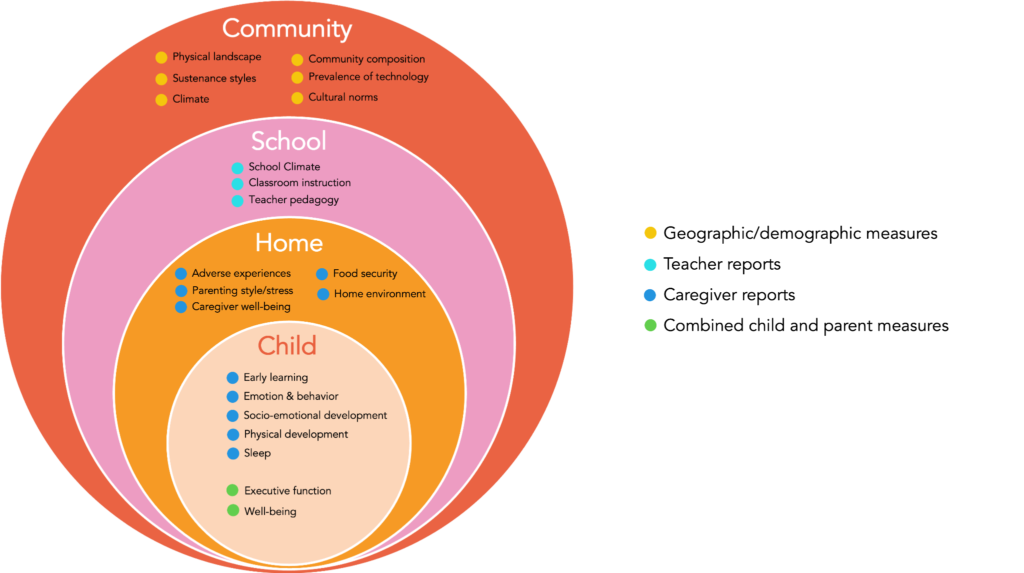
What LEVANTE can capture and help address
The constructs included in LEVANTE relate not only to the child and family members (e.g., the child’s socio-emotional development and caregivers’ well-being) but also the broader ecosystems in which they live. This construct set includes aspects of their home and school (e.g., classroom climate), extended community (e.g., cultural norms), and how actors within these contexts interact (e.g., quality of caregivers’ and teachers’ interactions).
To measure these constructs, LEVANTE adapts existing instruments developed by psychologists (e.g., the Self-Description Questionnaire assessing children’s perceived social support) and government agencies (e.g., the USDA Food Security Survey Module assessing families’ food security). The related tools have been established to be valid and reliable across varied contexts and ages. The main focus of LEVANTE lies not in developing new survey methods, but in harnessing existing tools to streamline questions that are engaging and easy for families and children to complete on our dashboard.
Critically, in LEVANTE’s core set of measures, we capture policy-relevant information, both in the form of individual behaviors and broader context metrics. Table 1 below provides examples of LEVANTE measures alongside related policy inquiries. (The table is non-exhaustive; for a full list, see the resources linked in the table notes.)
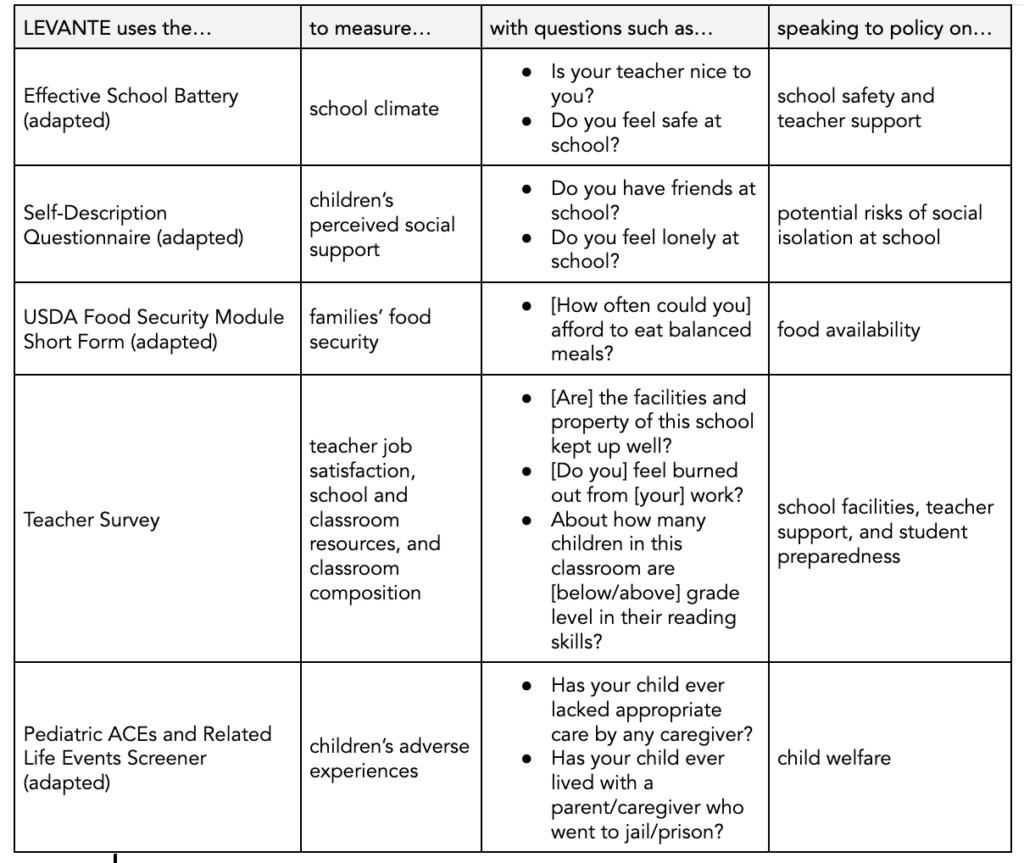
In combination, these measures tap multiple critical policy areas, ranging from education and food security to public health and environmental conditions. A notable strength of LEVANTE data is that it allows for investigating whether and how the relationship between factors—say, children’s perceived social support and adverse experiences—holds not just within but also across varied contexts. Of course, survey data alone, by design, do not directly resolve any one specific policy matter, societal challenge, or community need. However, LEVANTE measures can, at minimum, help supplement and guide decision-makers’ existing approaches to reach, engage, and understand the families and children under their purview.
What LEVANTE does not (yet) do
LEVANTE, by design, has a few limitations that decision-makers should be aware of.
First, LEVANTE data are not representative of the respective countries as a whole and also do not license inferences about country-level differences between locations.
Second, individual responses are not linked to personally identifiable information. Decision-makers may seek to understand how families and children’s experiences vary based on, say, specific neighborhoods; while we capture some related information, such as coarse geographic location, age, and gender, our data is blurred in ways that avoid individual reidentification.
Decision-makers also often take an interest in understanding the finer details of their communities’ concerns and experiences. These intricacies require qualitative methods that are not included in our condensed surveys.
Conclusion
Decision-makers around the world are already working hard to engage with their communities and keep them transparently informed. LEVANTE can contribute to these goals, with a particular focus on understanding the varied environments that children grow up in, how they relate to learning and development writ large, and making the resulting data and tools openly available. Building on broader advancements in science and technology, LEVANTE leverages established measures and furthers transparency through its structured data releases and publicly accessible tools. We hope that these advancements not only benefit researchers but also help enrich and guide decision-makers’ existing approaches to enacting policies for the families and children in their communities.
Further reading
ACEs Aware (2023). Pediatric ACEs and related life events screener. Center for Youth. https://www.acesaware.org/learn-about-screening/screening-tools/
Blumberg, S. J., Bialostosky, K., Hamilton, W. L., & Briefel, R. R. (1999). The effectiveness of a short form of the Household Food Security Scale. American journal of public health, 89(8), 1231-1234. https://doi.org/10.2105/AJPH.89.8.1231
Frank, M. C., Baumgartner, H. A., Braginsky, M., Kachergis, G., Lightbody, A. A., Sparks, R. Z., … & Dodge, K. A. (2025). Learning Variability Network Exchange (LEVANTE): A Global Framework for Measuring Children’s Learning Variability Through Collaborative Data Sharing. Child development, 96(6), 1867-1884. https://doi.org/10.1111/cdev.70011
Gottfredson, G. D. (1984). The Effective School Battery: User’s manual. Psychological Assessment Resources. https://eric.ed.gov/?id=ED273041
Kachergis, G., O’Reilly, F., Braginsky, M., Xiao, X., Lightbody, A., Shannon, K. A., … & Frank, M. C. (2025). Creation and validation of the LEVANTE core tasks: Internationalized measures of learning and development for children ages 5-12 years. https://europepmc.org/article/ppr/ppr1135280
Zimet, G. D., Dahlem, N. W., Zimet, S. G., & Farley, G. K. (1988). The multidimensional scale of perceived social support. Journal of personality assessment, 52(1), 30-41. https://doi.org/10.1207/s15327752jpa5201_2
For additional information please see https://researcher.levante-network.org/measures/measure-selection and https://researcher.levante-network.org/ethics-and-privacy.
AI statement
No AI tools were used to conceive or produce this post’s content.