Situating LEVANTE among measures of children’s learning
Children’s skills vary from child to child, from task to task, over time, and across settings. Existing measures capture parts of that variation well, but researchers still face trade-offs: narrow age ranges, difficulty adapting measures across languages and cultures, and, for some tools, paid licensing. So what does LEVANTE add?
What existing tools do well
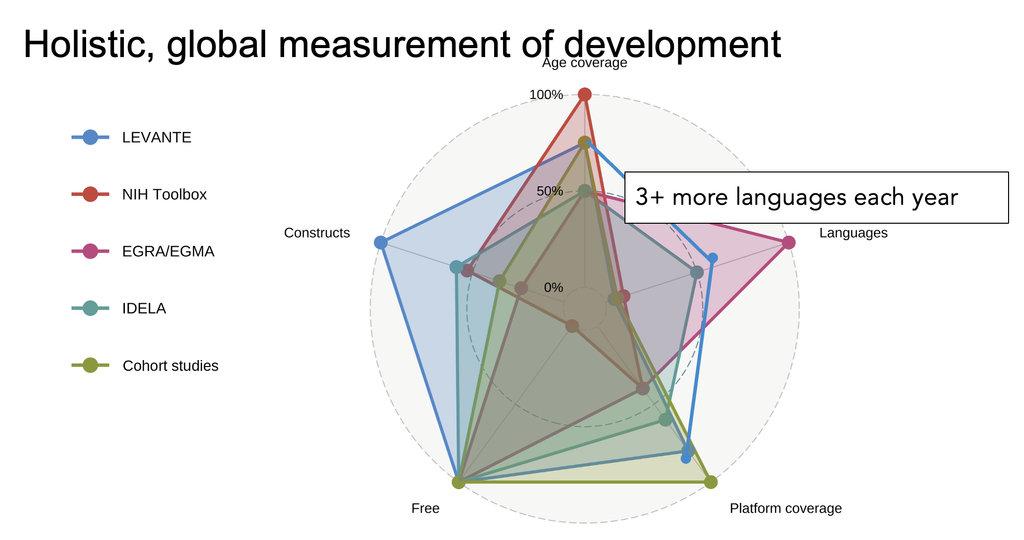
A few examples illustrate the strengths of existing approaches and where LEVANTE fits within the broader measurement landscape. EGRA and EGMA assess foundational reading and numeracy in the early grades and have been used widely: one analysis pooled 230 surveys from 48 countries (Crawford et al., 2025). IDELA, from Save the Children, is free and covers ages 3.5 to 6. A five-country study found it useful for tracking progress within countries but cautioned against comparisons across countries (Halpin et al., 2019), a caution that also applies to LEVANTE (see our previous post on this topic). The NIH Toolbox shares LEVANTE’s ambition to provide a “common currency” across studies and covers ages 3 to 85, though its reference scores are anchored to a 2021 US-representative sample (Ho et al., 2025). Birth cohorts, such as the Millennium Cohort Study and Future of Families, are datasets rather than instruments, but they show what is hard to do after the fact: they offer decades of follow-up and links to rich administrative data, yet their measures differ across studies, change as children grow, and are often country specific.
Each of these tools addresses important questions: Are children reading at a grade 2 level? Are they ready for school? How does a child compare with a reference group? Cohort studies also examine how differences between children evolve with age and context. What remains hard to find is a set of measures designed from the outset to be pooled into a shared, open dataset across many sites, languages, and ages, with harmonization built in and paired with measures of children’s contexts. This is the gap LEVANTE aims to fill.
What LEVANTE adds
The measures
- One battery for ages 5 to 12. LEVANTE uses the same core tasks across the whole range, with items shared across ages so that scores sit on one scale. This makes it possible to study development within a single study, using the same measures throughout. We plan to extend the battery to younger children.
- A shared, open battery. Every site uses the same core tasks, translated and localized where needed. Items shared across sites let us test whether tasks function consistently across settings. The measures are permissively licensed and free to use, and the data they generate are released publicly.
- Measures of context. Because our focus is how learning varies across contexts, LEVANTE pairs the tasks with surveys from children, caregivers, and teachers and, increasingly, geographic and school- and site-level data. This lets researchers ask how children’s home, school, and neighborhood environments relate to how their skills grow.
What the measures make possible
- A federated design. Sites can use LEVANTE with their own populations, in new studies or alongside ongoing ones, such as a 6,500-pair pregnancy cohort in Calgary or a birth cohort in India. This gives sites room to address local questions and lowers barriers to participation, and funded sites collect at least three waves of data over four years, so the same children are followed across ages. The trade-off is that samples vary across sites and may not represent wider populations. Because LEVANTE is observational, associations alone cannot establish causation. We think the trade is worthwhile for studying variability across contexts, but it shapes which questions the data can answer.
- Relationships rather than rankings. A common scale puts scores in the same units but does not make samples comparable. Sites differ in how they recruit participants and administer tasks, so comparing absolute performance across sites is not appropriate, and ranking sites is not a valid use of LEVANTE data. Instead, the design supports examining whether relationships recur across sites, for example whether a factor predicts growth in more than one setting. These comparisons still depend on measures functioning consistently across settings, a property known as measurement invariance. For the tasks tested so far, invariance largely holds, with exceptions among some language tasks (Kachergis et al., 2025), and we continue to assess it as new sites join. Where it does not hold, apparent differences in the strength of a relationship are hypotheses to investigate rather than findings about children’s development.
LEVANTE’s place in this landscape rests on the combination of these features. It complements established assessments and long-running cohorts by offering measures built to be pooled, giving researchers a shared foundation for studying learning across contexts. The value is cumulative: each participating study can address local questions while its data contribute to a broader understanding of which relationships hold across settings and which depend on context.
References
Crawford, M., Raheel, N., Korochkina, M., & Rastle, K. (2025). Inadequate foundational decoding skills constrain global literacy goals for pupils in low- and middle-income countries. Nature Human Behaviour, 9(1), 74–83. https://doi.org/10.1038/s41562-024-02028-x
Frank, M. C., Baumgartner, H. A., Braginsky, M., Kachergis, G., Lightbody, A. A., Sparks, R. Z., Zhu, R., Carlson, S. M., Graham, S., Lipina, S. J., Newcombe, N. S., Odgers, C. L., Pianta, R. C., Siegler, R. S., Snowling, M., Yoshikawa, H., Cubillo, A., & Dodge, K. A. (2025). Learning Variability Network Exchange (LEVANTE): A global framework for measuring children’s learning variability through collaborative data sharing. Child Development. https://doi.org/10.1111/cdev.70011
Halpin, P. F., Wolf, S., Yoshikawa, H., Rojas, N., Kabay, S., Pisani, L., & Dowd, A. J. (2019). Measuring early learning and development across cultures: Invariance of the IDELA across five countries. Developmental Psychology, 55(1), 23–37. https://doi.org/10.1037/dev0000626
Ho, E. H., Han, Y. C., LaForte, E. M., Kaat, A. J., Dworak, E. M., Ece, B., Yao, L., Olsen, J. B., & Gershon, R. C. (2025). Norming of the NIH Toolbox Cognition Battery Version 3. Assessment. https://doi.org/10.1177/10731911251386277
Kachergis, G., O’Reilly, F., Braginsky, M., Xiao, X., Lightbody, A. A., Shannon, K. A., Watson, Z., Zhang, L., Zhu, R., Abutto, A. B., Wanjing, A. M., Long, B., Murray, T., Yeatman, J. D., Sulik, M. J., Obradovic, J., Jenkins, N., Ansari, D., Perfetti, M. C., . . . Frank, M. C. (2025). Creation and validation of the LEVANTE core tasks: Internationalized measures of learning and development for children ages 5–12 years [Preprint]. PsyArXiv. https://doi.org/10.31234/osf.io/r4dhw_v1